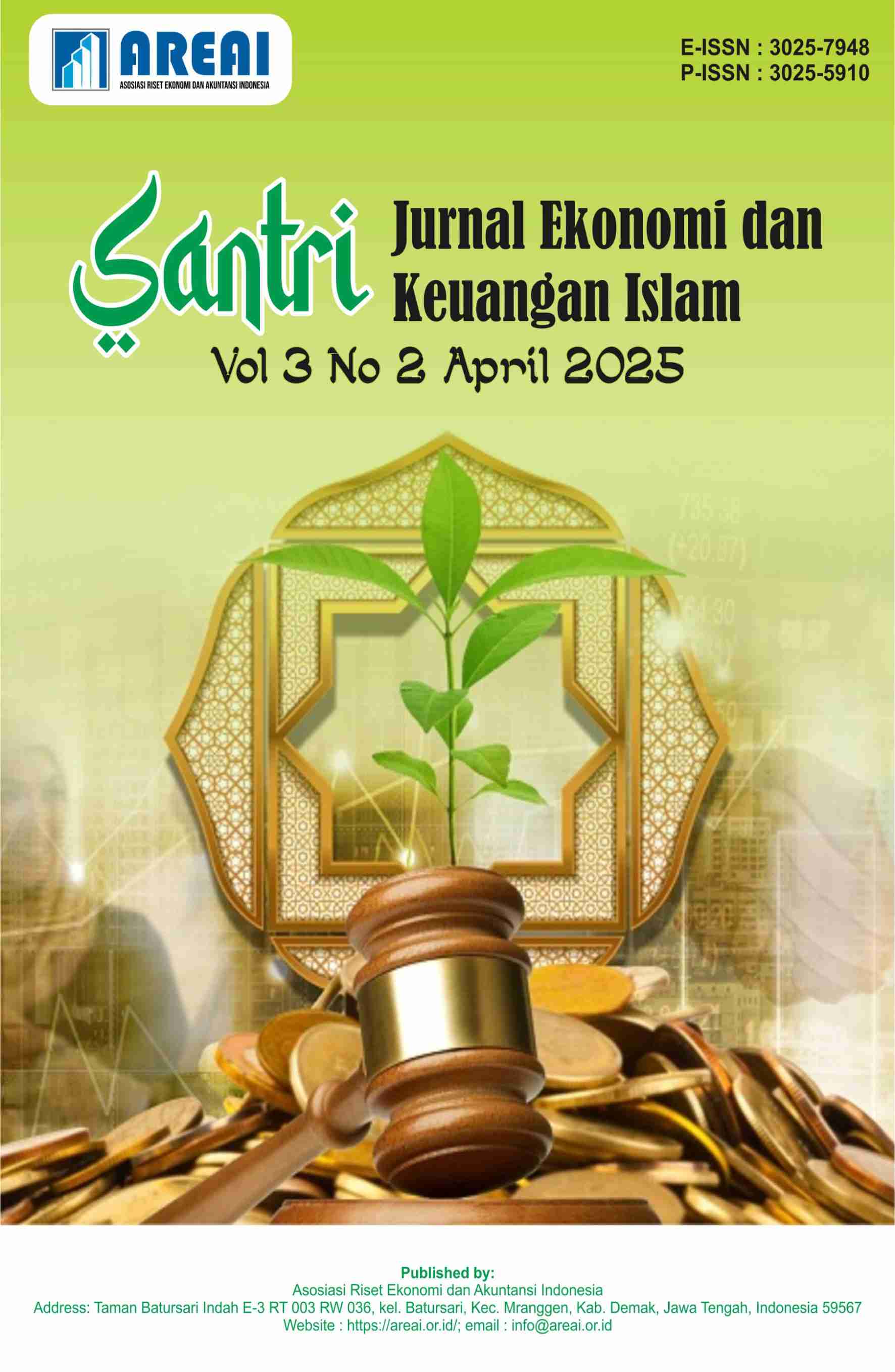
Fungsi Uang dalam Perspektif Abu Ubaid: Telaah Pemikiran Ekonomi Islam Klasik dan Relevansinya Saat Ini
DOI:
https://doi.org/10.61132/santri.v3i2.1369Keywords:
Abu Ubaid, Economic Justice, Function of Money, Islamic Economic Thought, Kitab al-AmwalAbstract
The history of Islamic economic thought has developed since the time of the Prophet Muhammad and continues to experience enrichment by Muslim scholars. These thinkers tried to build Islamic economic concepts that are relevant to the context of their times, while still based on the Qur'an and Hadith. One of the important figures in Islamic economic thought is Abu Ubaid, whose main work Kitab al-Amwal is the main reference in understanding the classical Islamic economic system. In his work, Abu Ubaid emphasizes the importance of justice as the main principle in economic management, including the use of money. He views money as having two main functions, namely as a standard of value and a medium of exchange. His views show strong relevance to the modern economic system, where the function of money still plays an important role in economic activity. This paper aims to examine in depth Abu Ubaid's thoughts on the function of money and assess its relevance in the context of contemporary economics.
Downloads
References
Ali Fahmi, M., & Nurul Qomariyah, L. (2022). Pemikiran Ekonom Islam Abu Ubaid tentang Fungsi Uang dan Relevansinya. Iqtisodina: Jurnal Ekonomi Syariah dan Hukum Islam, 5(Juni), 75–80.
Hidayat, T. (2019). Abu Ubaid sebagai Fuqha dan Ekonom: Critical Reading terhadap Corak Pemikiran dan Konsepsi Ekonomi Ibn Ubaid. Al-Falah: Journal of Islamic Economics, 4(1), 1–13. https://doi.org/10.29240/alfalah.v4i1.781
Nugroho, A. (2018). Pemikiran Ekonomi Islam Abu Ubaid (154-224 H): Fungsi Uang dan Relevansinya Saat Ini. Munich Personal RePEc Archive. https://www.cambridge.org/core/product/identifier/CBO9781107415324A009/type/book_part
Siagian, C. A., Ibrahim, R., Bintang, R. T., Ningrum, W., & Az-Zahra, Y. (2024). Pemikiran Ekonomi Abu ’Ubaid. Jurnal Penelitian dan Karya Ilmiah, 2(1), 211–224. https://doi.org/10.59059/mutiara.v2i1.946
Chapra, M. U. (2000). The Future of Economics: An Islamic Perspective. The Islamic Foundation.
Islahi, A. A. (2006). History of Economic Thought in Islam: A Bibliography. Islamic Research and Training Institute.
Al-Ghazali, A. H. M. (1991). Ihya' Ulum al-Din (Vol. 2). Dar al-Kutub al-‘Ilmiyyah.
Ibn Khaldun. (1967). The Muqaddimah: An Introduction to History (F. Rosenthal, Trans.). Princeton University Press.
Kahf, M. (2003). Islamic Economics: What Went Wrong?. Paper presented at the 6th International Conference on Islamic Economics, Jakarta.
Zarqa, M. A. (2003). Islamic Economics: An Approach to Human Welfare. Islamic Economic Studies, 11(2), 1–18.
Al-Maqrizi, T. (2012). Ighathah al-Ummah bi Kashf al-Ghummah. Dar al-Kutub al-‘Ilmiyyah.
Abu Yusuf. (2005). Kitab al-Kharaj (A. Ben Shemesh, Trans.). Dar al-Ma’rifah.
Umar, A. F. (2005). Ekonomi Islam: Suatu Kajian Teoritis dan Historis. Gema Insani.
Adiwarman Karim. (2016). Ekonomi Mikro Islami (3rd ed.). Rajawali Pers.
Karsten, L. (2006). Globalization and Islamic Finance: Convergence, Prospects, and Challenges. Edward Elgar Publishing.
Downloads
Published
How to Cite
Issue
Section
License
Copyright (c) 2025 SANTRI : Jurnal Ekonomi dan Keuangan Islam

This work is licensed under a Creative Commons Attribution-ShareAlike 4.0 International License.