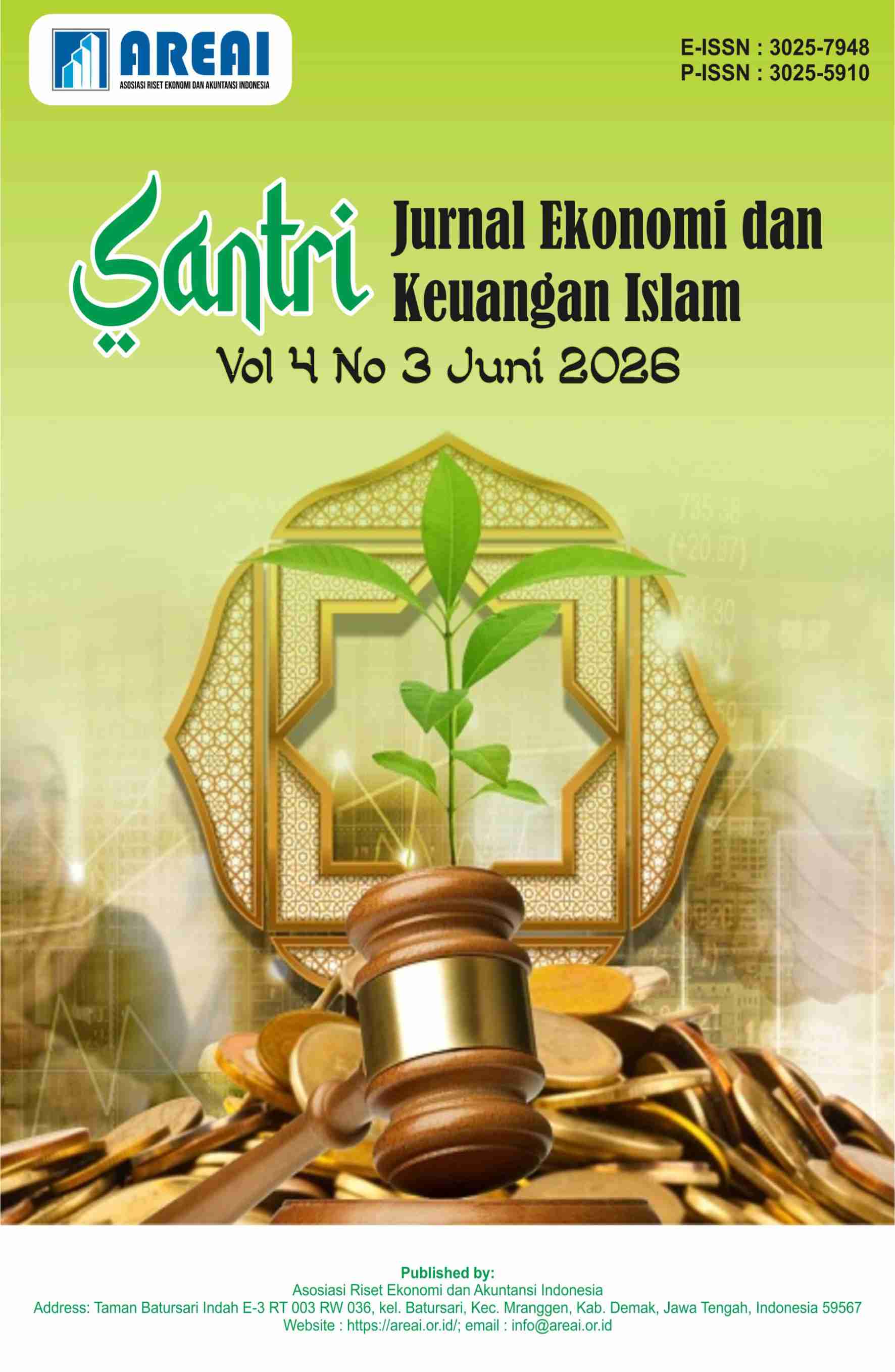
Kontribusi Zakat terhadap Pengurangan Kesenjangan Sosial Ekonomi Masyarakat Muslim
DOI:
https://doi.org/10.61132/santri.v4i3.2328Keywords:
Community Welfare, Islamic Economics, Socio-Economic Inequality, Wealth Distribution, ZakatAbstract
Zakat is one of the instruments of Islamic economics that serves both social and economic functions in promoting equitable social welfare. The persistently high level of socio-economic inequality in many Muslim countries has positioned zakat as an alternative solution for wealth redistribution and poverty alleviation. This study aims to analyze the contribution of zakat to reducing socio-economic inequality among Muslim communities based on various published studies. The research method employed is a literature review by examining relevant scientific articles from national and international journals published between 2020 and 2025. The findings indicate that zakat significantly contributes to reducing socio-economic inequality through income redistribution mechanisms, economic empowerment of mustahik (zakat beneficiaries), poverty reduction, and improvements in community welfare. Furthermore, productive zakat programs have been proven to be more effective in fostering economic independence compared to consumptive zakat. However, the effectiveness of zakat still faces several challenges, including low public awareness, suboptimal fund collection, and less-than-optimal governance of zakat institutions. Therefore, strengthening a professional, transparent, and technology-based zakat management system is necessary to enhance its contribution to achieving socio-economic justice within Muslim communities.
Downloads
References
Aini, R., Islam, U., & Sumatera, N. (2024). Kontribusi Zakat dan Wakaf Untuk Mencapai Tujuan Pembangunan Berkelanjutan : Solusi dalam Mengurangi Kesenjangan Sosial Ekonomi. 4(1), 1–7.
Alwi, A., & Mutmainnah, N. (2025). Dampak Kesenjangan Sosial dan Ekonomi terhadap Kesejahteraan Masyarakat di Kota Makassar. 9, 10602–10610.
Ardhana, D., Dalva, M., & Haq, A. (2024). The Role of Zakat in an Islamic Economic Perspective. 2(1), 660–666.
Artikel, R. (2026). DALAM SISTEM EKONOMI ISLAM Abstrak. 4(April), 30–36.
Hasan, A., Sovialencia, R. S., Wulandari, P. W., & Zahro, N. F. (2025). Kebijakan Fiskal dalam Ekonomi Islam. 3(1), 42–50.
Indonesia, D. I. (2024). Jurnal dinamika sosial dan sains. 367–372.
Juniar, F. (2024). Analisis Pemberdayagunaan Zakat Produktif Terhadap Kesejahteraan Mustahiq Pada Badan Amil Zakat Nasional ( Basnaz ) Kota Pontianak. 2.
Makraja, F. (2024). ZAKAT SEBAGAI INSTRUMEN EKONOMI ISLAM DALAM. 3(1), 113–126.
Mikraj, A. L., & Hamran, R. G. (2024). Optimalisasi Dana Zakat Untuk Mengatasi Masalah Kemiskinan di Indonesia. 5(1), 148–157.
Muttaqin, I., & Nugraha, A. (2026). Peran Zakat dalam Pertumbuhan Ekonomi , Pengurangan Kemiskinan , dan Kesenjangan Sosial di Indonesia. 7(1), 116–120.
Nurrahman, M. W., & Rosyadi, S. (2024). The Role of Zakat in Empowering the Economic Welfare of the Muslim Community : Fiqh Perspectives and Implementation in Indonesia. 2(1), 11–18.
Saputra, A., & Sutopo, H. (2024). Impact Assessments Peran Zakat dalam Pengentasan Kemiskinan : Tinjauan Komprehensif Penilaian Dampak Ekonomi. 1(5), 242–255.
Sutikno, J. D. (2025). ISSN : 2828 - 6103 AMAL : Jurnal Ekonomi Syariah ZAKAT SEBAGAI INSTRUMEN EKONOMI ISLAM DALAM UPAYA PEMERATAAN EKONOMI MASYARAKAT ISSN : 2828 - 6103 AMAL : Jurnal Ekonomi Syariah. 7(01), 42–49.
Syariah, K. E. (n.d.). Jurnal At-Tamwil. 07(02), 189–202.
Ulhak, M. Z. (2025). Peran zakat dalam mendorong pembangunan ekonomi berkelanjutan untuk mencapai kesejahteraan sosial yang inklusif. 2(2), 169–179.
Downloads
Published
How to Cite
Issue
Section
License
Copyright (c) 2026 SANTRI : Jurnal Ekonomi dan Keuangan Islam

This work is licensed under a Creative Commons Attribution-ShareAlike 4.0 International License.