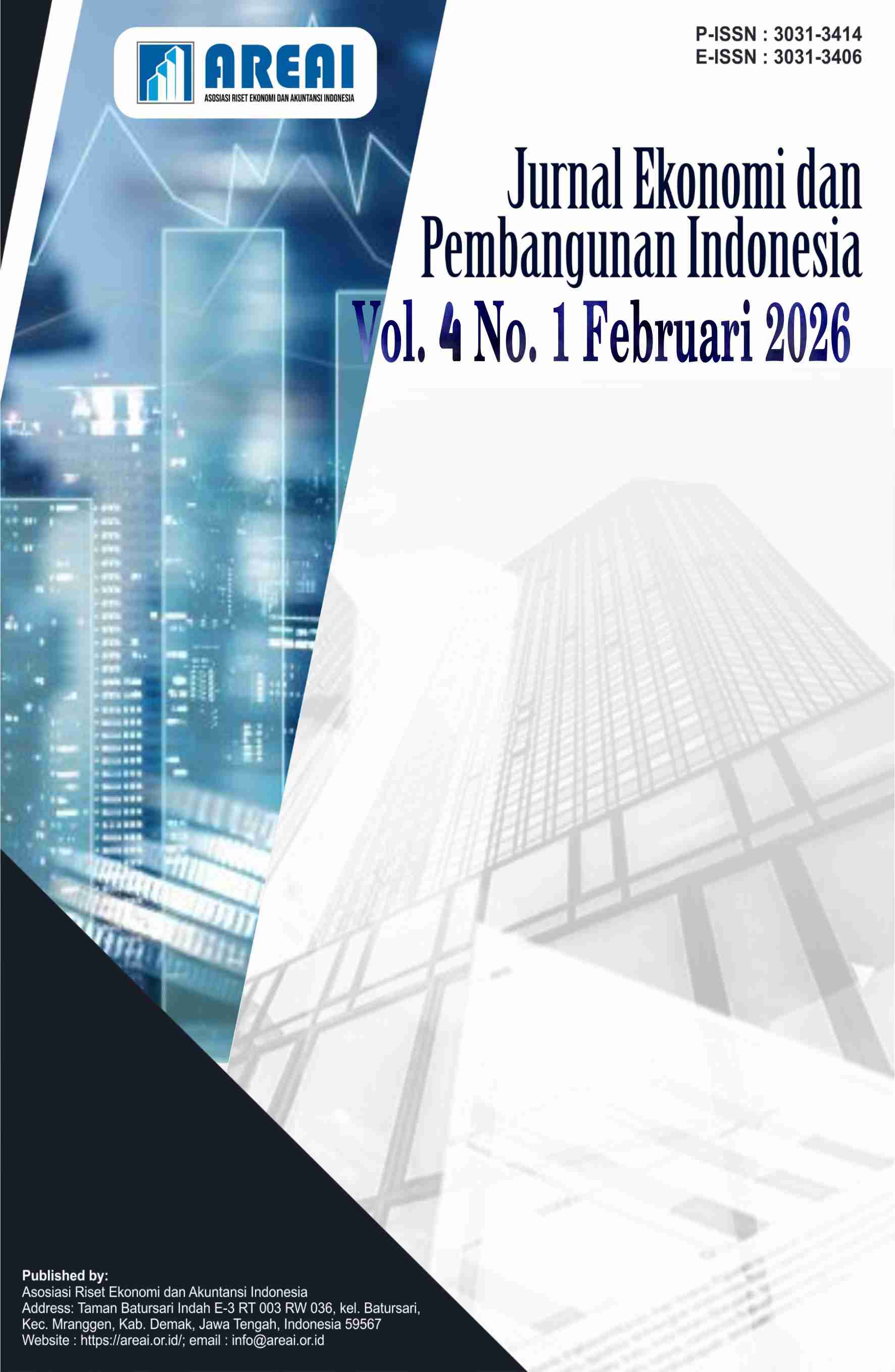
Pengaruh Tingkat Upah, Pertumbuhan Ekonomi, dan Indeks Pembangunan Manusia (IPM) terhadap Ketimpangan Pendapatan pada Kabupaten/Kota di Provinsi Jambi
DOI:
https://doi.org/10.61132/jepi.v4i1.2136Keywords:
Economic Growth, HDIAbstract
The purpose of this study was to determine and analyze the effect of wage levels, economic growth, and the Human Development Index (HDI) on income inequality through labor absorption in the Districts/Cities of Jambi Province from 2020-2024. The research method used is a quantitative descriptive analysis using panel data regression with the Fixed Effect Model approach. The analysis method used Eviews 12. The results showed of that partially, income inequality in the Districts/Cities of Jambi Province is significant positive influenced by the wage level variable, while economic growth does not have a significant effect on income inequality. In addition, the Human Development Index (HDI) has a significant negative effect on income inequality. This implies that wage increases are actually followed by in income inequality. Meanwhile, economic growth has not been able to provide a broad income redistribution effect. Conversely, improving the quality of human development proves to be the most effective factor, as it is capable of significant reducing inequalirt levels. Simultaneously, the results show that the variables of wage levels, economic growth, and the Human Development Index (HDI) collectively have a significant influence on income inequality in Districts/Cities of Jambi Province.
Downloads
References
Arsyad, L. (2010). Ekonomi pembangunan (5th ed.). UPP STIM YKPN.
Heni Meidiyan, Asrini, & Irmanelly. (2025). Pengaruh upah minimum, pertumbuhan ekonomi, dan indeks pembangunan manusia terhadap ketimpangan pendapatan di Provinsi Jambi. Ekopedia: Jurnal Ilmiah Ekonomi, 1(3), 623–636. https://doi.org/10.63822/0pa9km04
Janah, M. (2022). Analisis pengaruh tingkat PDRB per kapita, indeks pembangunan manusia, dan penanaman modal asing terhadap ketimpangan pendapatan di Indonesia periode tahun 2019–2021. Profit: Jurnal Manajemen, Bisnis dan Akuntansi, 1(4), 23–43. https://doi.org/10.58192/profit.v1i4.183
Julihanza, A., & Khoirudin, R. (2023). Determinan ketimpangan pendapatan di seluruh provinsi di Sumatera. Journal of Macroeconomics and Social Development, 1(2), 1–12. https://doi.org/10.47134/jmsd.v1i2.93
Karimi, K., Mulyani, P., Murialti, N., & Tibrani, T. (2023). Pengaruh penanaman modal asing, indeks persepsi korupsi, kemiskinan, pengangguran, dan upah minimum terhadap ketimpangan pendapatan di Indonesia. Jurnal Akuntansi dan Ekonomika, 13(1), 107–116. https://doi.org/10.37859/jae.v13i1.4775
Mankiw, N. G. (2014). Principles of economics (7th ed.). Cengage Learning.
Maorencia, Q. M., & Marwan, M. (2023). Pengaruh pertumbuhan ekonomi, investasi, dan indeks pembangunan manusia terhadap ketimpangan pendapatan di Indonesia. Arzusin, 3(5), 571–580. https://doi.org/10.58578/arzusin.v3i5.1672
Nengsih, E. H., Tan, S., & Achmad, E. (2023). Analisis ketimpangan pendapatan dan faktor-faktor yang mempengaruhinya di kabupaten/kota Provinsi Jambi. J-MAS (Jurnal Manajemen dan Sains), 8(2), 1898–1906. https://doi.org/10.33087/jmas.v8i2.1498
Putri, R. N., & Hanifa, N. (2024). Pengaruh pertumbuhan ekonomi, upah minimum, dan pengangguran terhadap ketimpangan pendapatan Jawa Timur. Independent: Journal of Economics, 4(3), 105–114. https://doi.org/10.26740/independent.v4i3.65963
Rahayu, Y. (2019). Pengaruh upah minimum provinsi dan PDRB terhadap penyerapan tenaga kerja di Provinsi Jambi. Jurnal Development, 7(2). https://doi.org/10.53978/jd.v7i2.143
Salsabila, N. A., & Pramukty, R. (2023). Pengaruh investasi, indeks pembangunan manusia, dan tingkat pengangguran terbuka terhadap ketimpangan distribusi pendapatan. EKOMA: Jurnal Ekonomi, Manajemen, Akuntansi, 2(2). https://doi.org/10.56799/ekoma.v2i2.1586
Sutiono, F., & Syafitri, W. (2018). Belanja kementerian/lembaga, belanja APBD, kontribusi sektoral, dan ketimpangan pendapatan di Jawa Timur. Indonesian Treasury Review: Jurnal Perbendaharaan, Keuangan Negara dan Kebijakan Publik, 3(3), 186–201. https://doi.org/10.33105/itrev.v3i3.75
Sutomo, D. A. (2023). Analisis ketimpangan pendapatan di Indonesia periode 2010–2021 (Doctoral dissertation, Universitas Hasanuddin). https://repository.unhas.ac.id/id/eprint/28598/
United Nations Development Programme (UNDP). (2010). Human development report 2010: The real wealth of nations—Pathways to human development. http://hdr.undp.org
Wulandari, D. A., Zulgani, Z., & Achmad, E. (2025). Analisis pengaruh pertumbuhan ekonomi dan upah minimum kabupaten terhadap ketimpangan pendapatan di dalam Provinsi Jambi. Jurnal Ilmiah Ekonomi dan Manajemen, 3(11), 513–520. https://doi.org/10.61722/jiem.v3i11.7218
Downloads
Published
How to Cite
Issue
Section
License
Copyright (c) 2026 Jurnal Ekonomi dan Pembangunan Indonesia

This work is licensed under a Creative Commons Attribution-ShareAlike 4.0 International License.